Promoting and Strengthening Fair Workplace Practices for Women Workers (PROFEM)
Violence, harassment, and other forms of workplace mistreatment continue to affect women working in Honduras’ export-oriented manufacturing, or maquila, sector, one of the country’s largest sources of employment for women. Fear of retaliation, limited awareness of labor rights, the normalization of harmful workplace practices, and uncertainty about available support and complaints mechanisms can make it difficult for workers to recognize and respond to these situations.
PROFEM (Promoción y Fortalecimiento de Prácticas Laborales Justas para Mujeres Trabajadoras, or Promotion and Strengthening of Fair Labor Practices for Women Workers) was a technical assistance initiative to strengthen the capacities of women maquila workers and the people and institutions that can support them in exercising their labor rights.
Our Work and Approach
Building on AIR’s Creating Opportunities to Strengthen Labor Rights (COSER) project, which focused on strengthening government labor authorities and private sector compliance, PROFEM engaged additional actors within Honduras’s labor ecosystem, including women workers and union leaders, legal and human resources professionals, the Honduran Bar Association, and the Universidad Tecnológica de Honduras, further strengthening the ecosystem of actors with roles preventing, identifying, and responding to workplace discrimination, violence, and harassment.
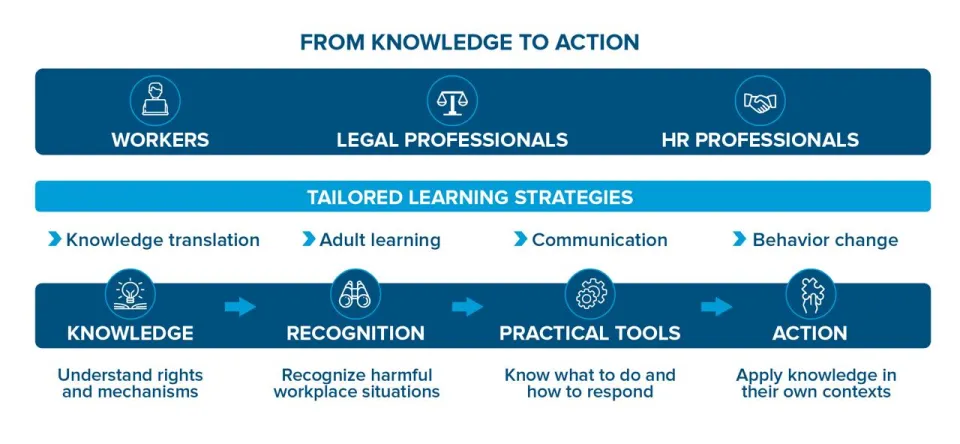
PROFEM was grounded in a simple premise: awareness of labor rights is important, but knowledge alone is not enough to produce meaningful change and actions.
The project combined knowledge translation, adult learning, communication, and behavior change approaches to create learning experiences tailored to the different roles and needs of women workers, legal professionals, and human resources professionals.
Rather than simply sharing information, the approach helped participants move from knowledge to recognition and practical action—understanding their rights, identifying workplace mistreatment, knowing how and where to seek support, and applying what they learned and new tools within their own contexts.
Our Results
93 women maquila workers and union leaders participated in training.
111 legal and human resources professionals strengthened their capacities.
25 professionals participated in Training-of-Trainers processes to support local replication.
I also learned to identify many forms of violence that are very subtle... I would say these are behaviors that we have normalized or that are somehow embedded in society, and that we sometimes overlook—whether as workers, employers, or legal professionals.
Legal Professional
Evidence from follow up data collection several months after PROFEM demonstrated that women and union workers applied what they learned, sharing concrete stories where they identified mistreatment in their workplaces, made more informed decisions in these cases, and took specific actions, including supporting and accompanying their peers to navigate reporting mechanisms.
86% of women workers participants reported feeling motivated to share the information they gained during the training with others.
We also found that 95% of legal professionals and human resources staff who participated in our programming applied their knew knowledge and tools within their professional practice several months following their training.