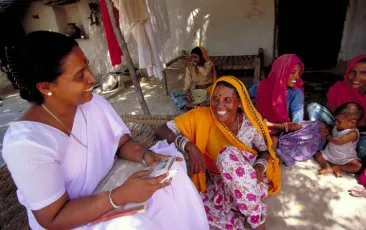
Women and girls in low-and middle-income countries continue to fall behind because of societal and structural barriers that limit their education, employment, and health opportunities. As a result, their economic status and well-being suffer.
We conduct research and evaluations and provide technical assistance to improve women and girls' lives by working with communities and development agencies.
Our Work
AIR’s work focuses on strengthening, expanding, and disseminating the global evidence base on how to improve the lives of women and girls. This includes generating and synthesizing evidence on the impact, cost-effectiveness, and scalability of women’s groups in India, Nigeria, and Uganda, as well as examining the impact of cash transfers on women’s self-reliance in various countries in sub-Saharan Africa. In addition, AIR conducts research and provides technical assistance on girls’ education. Recent examples of work include the following:
- A research agenda on women’s groups and COVID-19;
- Guidelines to measure women’s self-reliance in impact evaluations of women’s groups;
- Guidelines to estimate the cost-effectiveness of women’s groups;
- An evaluation of a men’s engagement program in Nigeria;
- A systematic review on the effects of economic self-help group programs on women’s empowerment; and
- A systematic review on the effects of vocational and business training on women’s labor market outcomes.
In addition to these specific projects, AIR's approach allows it to go beyond measuring women’s self-reliance and include analyses relations between men and women and social norms. To achieve this objective, AIR's approach is sensitive to women's issues and applies to various steps in the life cycle of research, evaluation, and technical assistance. This includes a co-ed research team, the consideration of implications based on whether a male or female is being asked research questions, and the design of research, evaluation, and technical assistance in a manner that considers women, including quantitative and qualitative data collection instruments, and female-focused data analysis.