Artificial Intelligence at AIR
The transformative potential of artificial intelligence (AI) is changing how we approach urgent social challenges. At AIR, our experts are exploring innovative ways to apply AI and AI-enabled tools to solve real-world problems and improve lives. When used responsibly, these technologies can help automate routine tasks, inform decision-making, and support new products and services that benefit communities.
However, more evidence is needed on what works, for whom, and under what conditions. We must also better understand the environmental impacts of AI and actively address risks such as bias, reliability, and quality control. AIR is helping fill these gaps by generating rigorous evidence, testing AI-enabled approaches in practice, and advancing responsible guardrails for AI use.
The AIR Century Study
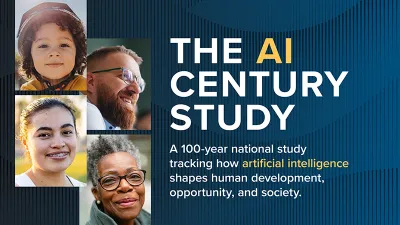
How does the age of AI change the human condition? That’s the question behind AIR’s AI Century Study. We'll share updates and findings as the work unfolds.
Our Work
Explore a selection of our AI research, evaluation, and implementation work below.
AI for Workforce & Skills

ACT-AI: Helping People Land Better Jobs Using AI
Testing how AI can improve job search and job attainment for aspiring tech professionals.
Intelligent Tutoring Systems for Sectoral Training
Assessing adaptive tutoring tools to strengthen training completion and learner outcomes.
Building an AI-Ready Workforce in Miami
Connecting learners to AI-driven career pathways through regional partnerships.
The Role of AI in Workforce Development
Exploring how AI can expand flexible, affordable workforce training.
AI for Public Programs & Operations

Federal Health Insurance Marketplace Operations Support
Using AI to streamline workflows, improve accuracy, and increase efficiency in public service operations.
Administrative Data and Research Analysis (ADRA) Project
Supporting access to labor data while advancing research on machine learning and program improvement.
AI for Education

AI by 8: The Importance of Early Artificial Intelligence Education
Co-designing and testing “unplugged,” literacy-aligned K–2 lessons that build foundational AI literacy for young learners in rural North Carolina.
Evaluating and Comparing AI Tools for Teachers
Building benchmarks and a virtual testbed to compare AI tools for classroom use.
Using AI to Enhance Educator Feedback (CAFE)
Supporting teachers with faster, actionable feedback through an AI-enabled platform.
Evaluating the ADAPT-AI Formative Assessment Tool
Testing a human–AI tool that helps teachers design adaptive formative science assessments.
Teaching with AI: Testing the Promise and Empowering Educators
Studying how teachers use AI and testing training modules for responsible classroom practice.
Responsible AI & Governance

Advances and Challenges in Evaluating LLM-Based Applications
Practical approaches to evaluating custom LLM tools—and the barriers to faster, safer progress.
Fair Play or False Start? AI-Generated Data and Measurement Bias
Studying when AI-generated responses can support validation without compromising measurement quality.
AI Action Plan Input (OSTP RFI Response)
Policy recommendations to encourage innovation, competition, and practical AI adoption.
AI for High-Quality Research Syntheses (Incubator)
Developing AI methods to accelerate research synthesis with stronger automation and reliability.
Our Approach to Responsible AI
AIR is committed to generating rigorous evidence and advancing responsible, ethical practices for AI use.
When we incorporate AI or AI-enabled tools into our work, we do so with clear goals, rigorous testing, and ongoing human oversight. Our policies and procedures uphold strong standards for data privacy, security, documentation, and quality control. We also apply practical safeguards—such as bias checks, validation of results, and monitoring over time—to support reliable, evidence-based decisionmaking.
As AI technology and our understanding of its impacts evolve, we regularly review and refine our approach. Our aim is to harness AI in service of the public good while proactively mitigating risks to the clients and communities we serve.