AI in Schools is In Demand—But How Is It Working? The AIxED Research Network
Artificial intelligence (AI) is rapidly reshaping education. Educators, leaders, and policymakers are facing urgent questions about how to safely use AI in ways that benefit all students. Yet there is limited rigorous evidence to guide how AI is used in K–12 settings.
To address this need, AIR created the AI in Education Network (AIxED Research Network).
Building Our Understanding of AI’s Impact as It's Applied in Education
The AIxED Research Network connects researchers, educators, and system leaders to study and strengthen the use of AI in education. The network includes six studies designed as a connected body of work to increase the impact of the research.
The network emphasizes rigorous, collaborative approaches to building evidence that generates actionable findings. It prioritizes sharing learnings quickly and consistently to meet the need of the moment, answering pressing questions such as:
- How can AI enhance instruction, assessment, and leader decision-making?
- To what extent does AI change the way teachers spend their time?
- Does AI enable more differentiated instruction for students?
Grounding Research in the Realities of Education
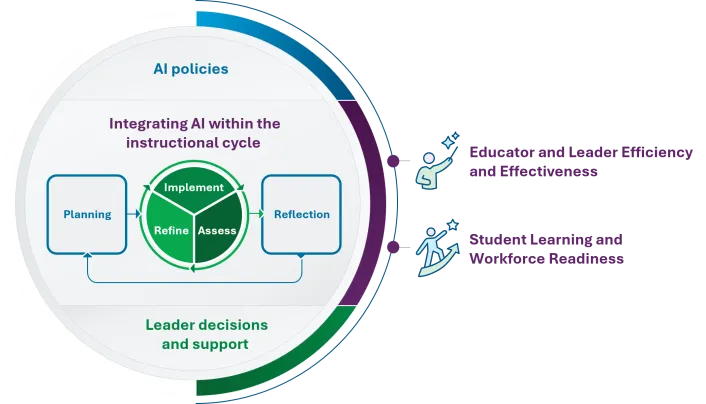
Together, the projects in the network reflect the realities of how AI is being applied in education. The figure below illustrates several critical points centered around the idea that AI does not affect teaching and learning on its own—it operates within a broader system that includes policies, leaders, and educators.
Policies related to AI in education are evolving at the local, state, and federal levels. These policies shape the decisions leaders make about how AI is used in schools. At the center of these decisions are educators and the instructional cycle. Educators continuously plan, implement, refine, assess, and reflect on their teaching practices, and AI may be integrated into each part of that process.
In the AIxED Research Network, our teams work closely with partners to examine these AI uses and test whether the intended outcomes of greater efficiency and effectiveness for educators and leaders, improved student learning, and increased workforce readiness are realized.
AI in Education Network Logic Model
Our work is grounded in AIR’s AI Implementation Framework and AI Education Research Principles. In addition, we use a set of common measures across projects to enable broader learning across the research studies about the impact of AI in education.