Evaluating the Impact of Early College High Schools

States have prioritized college and career readiness as a key goal of high school, reflecting the reality that most jobs require postsecondary education. But many students, particularly those who are low-income and/or of color, lack access to a well-rounded high school education. Inadequate preparation in high school leaves high school graduates with fewer choices and pathways to postsecondary education. As a result, postsecondary enrollment and completion gaps between students from disadvantaged backgrounds and their peers persist. Early College High Schools focus explicitly on overcoming these challenges.
What Is an Early College High School?
Jointly operated by school districts and postsecondary institutions, Early Colleges are either whole school program or programs within schools designed to serve students traditionally underrepresented in higher education.
A special type of dual enrollment program, Early Colleges offer students the opportunity to earn a high school diploma and an associate degree or up to two years of college credits toward a bachelor’s degree in high school—at no or low cost to their families. Early Colleges also provide rich academic and social supports to students to help them succeed in their college courses and plan for college after high school.
The Early College High School Initiative (ECHSI) was established in 2002 by the Bill & Melinda Gates Foundation, along with the Carnegie Corporation of New York, the Ford Foundation, and the W.K. Kellogg Foundation. Over the past two decades, Early Colleges have expanded rapidly nationwide.
Since this trend began, AIR researchers have conducted a rigorous impact study and two follow-up studies of Early Colleges. They found significant and positive effects of Early Colleges on both high school and college outcomes for all students, providing strong evidence that promoting postsecondary access and success can be an effective policy strategy for improving postsecondary enrollment and completion rates.
Immediate and Lasting Benefits of Early College High Schools: Previous Findings from AIR's Early College Research
For an overview of AIR’s research on Early Colleges, check out this interactive brief.
AIR first studied the implementation of Early Colleges and, later, their impact on students. AIR's research shows that the impact of Early Colleges on student outcomes has been consistently positive, and that Early Colleges equally benefit all students—regardless of gender, race/ethnicity, or family income—not just economically disadvantaged students or students traditionally underrepresented in higher education.
More findings from Early College studies across the years:
Evaluating the Longer-Term Impact of Early College High Schools on Workforce and Life Outcomes (2021-2024)
AIR recently conducted a second Early College efficacy follow-up study funded by the Institute of Education Sciences. Starting in 2021, this study was designed to build off AIR’s original Early College impact study and the first follow-up study to assess the longer-term impact of Early Colleges on college degree completion, workforce, financial, and other life outcomes up to 14 years after students’ expected high school graduation.
To this end, AIR collaborated with the National Opinion Research Center at the University of Chicago to administer a follow-up survey to the original impact study participants. The survey was administered from September 2022 to March 2023 using both electronic and paper-and-pencil instruments.
Study findings revealed that initial impacts on bachelor’s degree attainment and advanced degree attainment were no longer significant 10 years after expected high school graduation.
The study also found that differences in associate degree attainment remained large and significant, with approximately 30% of Early College students and 12% of students in the comparison group earning an associate degree within 10 years after expected high school graduation. Despite this positive impact on overall degree attainment, we did not observe significant Early College impacts on students’ workforce, financial, or other life outcomes.
Impacts on bachelor’s degree attainment significantly differed by students’ race/ethnicity. Although the Early College impact was not statistically significant among White and Asian students, students from an underrepresented minority background (e.g., Black, Hispanic, Multiracial) who were accepted to an Early College were significantly more likely to complete a bachelor’s degree than underrepresented minority students who were not accepted to an Early College (a difference of 12 percentage points for bachelor’s degree completion within 10 years after expected high school graduation).
National Database and Map of Early College Programs
As part of the current follow-up study, AIR has developed a national database of Early Colleges and an interactive map that provide the location and key information about ECs throughout the U.S.
Mapping Early College Programs Across the U.S.
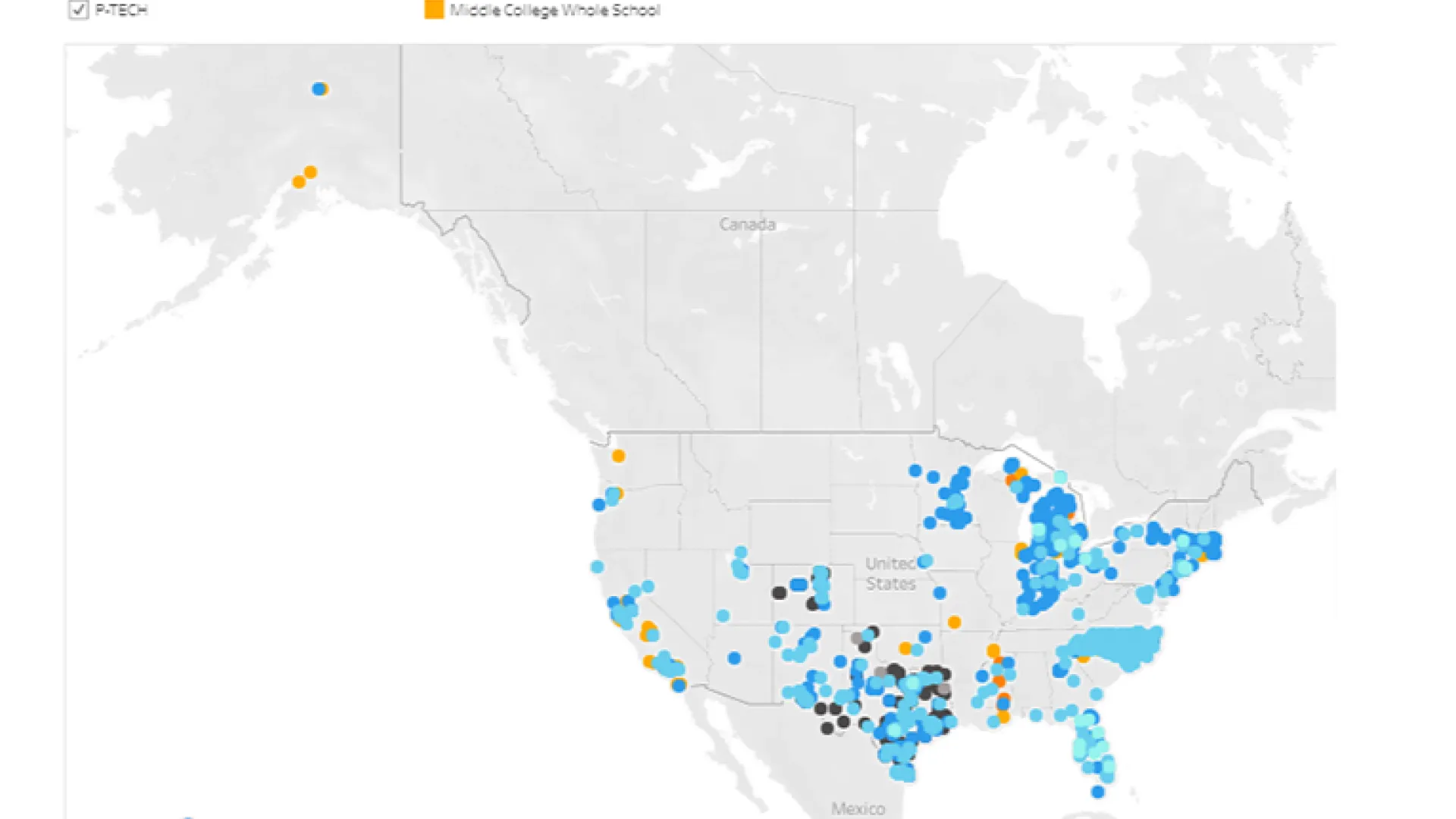
Although AIR researchers searched websites and contacted representatives in each state to identify all existing Early Colleges, it is possible that some Early Colleges have been overlooked or key information about certain Early Colleges was not publicly available.
To increase the accuracy and relevance of this database and map, AIR researchers created a survey for schools and programs to request their inclusion or an update to information in the national database. AIR will continue to add Early Colleges to the database and map as more information is collected through the survey. Please email Sara Mitchell if you have any questions about the database or the map.
First Follow-up Study (2016-2019)
The First Follow-up Study found that Early College students continued to enroll in college and complete college degrees at significantly higher rates than students in the comparison group up to 6 years after expected high school graduation.
- Early College, Continued Success: Longer-Term Impact of Early College High Schools (2019)
- How Did Early College High Schools Affect Students' Postsecondary Outcomes? (Infographic, 2019)
A Cost-Benefit Analysis conducted as part of the first follow-up study found that, over four years of high school, Early Colleges cost about $3,800 more per student than traditional high schools. However, the average estimate of lifetime benefits of enrolling in an Early College is $57,682 per student, with $33,709 per student in private benefits and $23,973 per student in public benefits.
- The Costs and Benefits of Early College High Schools (2019)
- The Lasting Benefits of Early College High Schools: Considerations and Recommendations for Policymakers (2020)
Initial Impact Study (2010-2013)
The Initial Early College Impact Study found that Early College students had significantly higher achievement test scores in English language arts and were more likely to graduate from high school than students in a comparison group with similar characteristics who were not enrolled in Early Colleges.
Analyses of survey data indicated that Early College students were more likely to accrue college credits during high school and reported greater instructional rigor, a stronger college-going culture, and greater support from their instructors than comparison students. In addition, the study found that Early College students were significantly more likely to enroll in college and earn a college degree than students in the comparison group.
- Early College, Early Success: Early College High School Initiative Impact Study (2013)
- Early College, Continued Success: Early College High School Initiative Impact Study (2014)
- Early College Means Early Success for Students: Results from the Early College High School Initiative Impact Study (Summary, 2014)
Descriptive Study of the Early College High School Initiative (2002-2009)
The 2002–2009 Descriptive Study of the Early College High School Initiative found that, in high school, Early College students earned an average of 23 college credits by the time they graduated, and 88 percent of graduates had enrolled in college the fall after graduation. In interviews, alumni of Early Colleges “generally felt their schools had effectively prepared them to manage their time and to be successful in rigorous classes,” and “capable of navigating the college system and comfortable becoming involved in campus life.”