Attendance Policy Partnership

In 2022-23 school year, data from 20 states indicated that more than 30% of their students missed more than three weeks of school. Since COVID, many states have been evaluating their attendance policies to determine how policies may be impacting student attendance.
Most state attendance policies include seat time requirements that dictate how much time students should physically spend in school and truancy systems designed to enforce consequences for families and youth who have missed too many days of school.
For this project, AIR worked with two states who were interested in examining their attendance policies in an effort to increase student attendance rates.
About the Attendance Policy Partnership
The APP was a collaboration between AIR and the New Jersey Department of Education and partner districts, the Washington State Office of Superintendent of Public Instruction, and the Puget Sound Educational Service District.
The goal of the APP project team was to expand the evidence base for how attendance policies and their implementation can be used to increase attendance for youth.
The project team worked with each state to identify an aspect of attendance to pursue based on available data. In addition to reviewing quantitative attendance data, qualitative data was collected to reflect perspectives from school leaders, parents, and students who had lived experience with absenteeism and/or truancy. After exploring the data, AIR collaborated with partner states to share research and evidence-based approaches to attendance policy and practice implementation.
Products and Resources
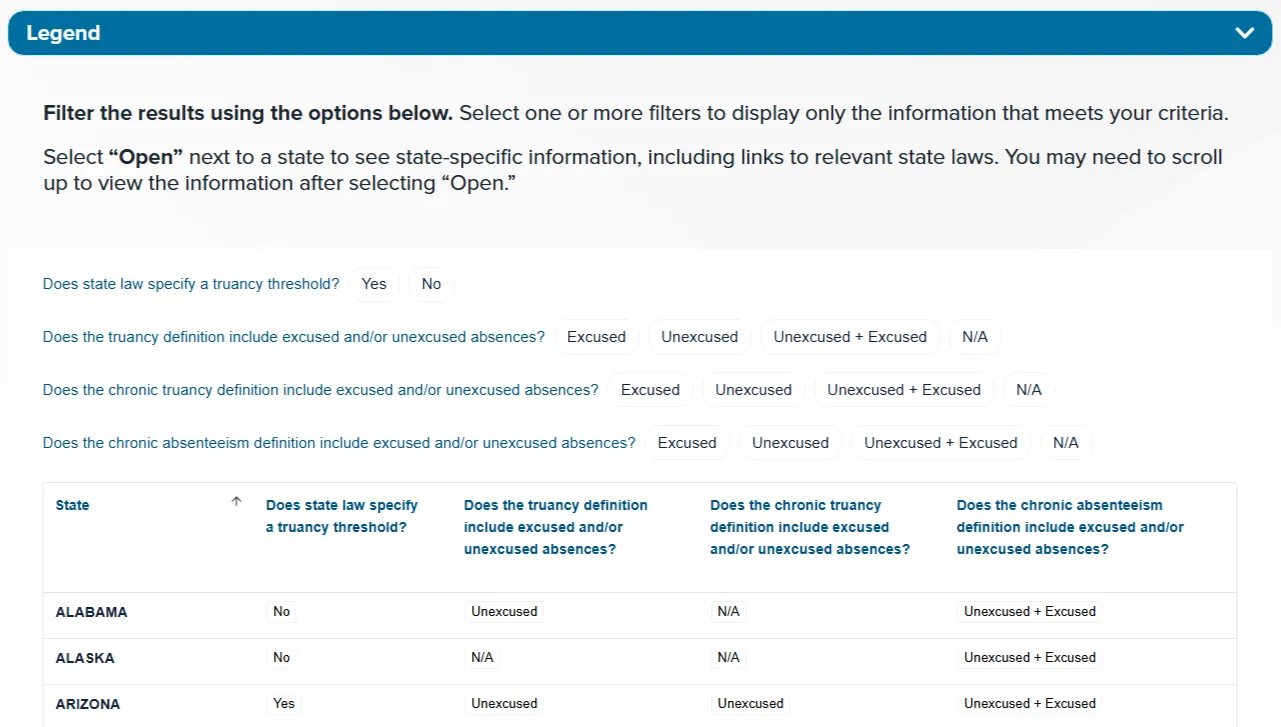
State Attendance, Truancy, and Chronic Absenteeism Policy Database
The State Attendance Policies Database offers a state-by-state look at how attendance, truancy, and chronic absenteeism are defined across the country. Developed to be a resource for educators, policymakers, and researchers, this database compiles statutory definitions and attendance benchmarks.
Excused Mental Health Absences: Current Policies and Implementation Considerations for Educational Leaders
Addressing chronic absenteeism and supporting youth mental health are interconnected priorities for school communities nationwide. One emerging strategy at their intersection is amending attendance policies to designate mental and/or behavioral health as an excused absence, with 17 states having passed legislation in recent years. While research on the policy’s uptake and effectiveness is still limited, the current discourse explores promising practices and potential implications based on related evidence-based practices.
Developed through the AIR Opportunity Fund to support educational leaders who are exploring or enacting excused mental health absence policies, this brief summarizes the current policy landscape and offers key considerations and practical tools for effective implementation. A separate template mental health days tip sheet is also included as a resource that can be adapted by school communities to share with students and families.
Strategies to Increase Attendance
Developed in partnership with the state of New Jersey’s Continuous Improvement Collaborative, the Attendance Strategy Library is an accessible collection of research-based tools and strategies for school leaders and district teams seeking to reduce chronic absenteeism. The curated library groups resources by tier of intervention and key focus areas, and provides actionable guidance for building capacity, gathering data, and implementing interventions tailored to individual school context.
To help educators maximize the impact of the library, an introductory video offers step-by-step instructions and practical tips for navigating and applying the included strategies.