Center on Great Teachers and Leaders
Building bridges from today's educator workforce challenges to a future where every student can thrive while learning from a talented educator workforce.

Resources
Can't Find What You Are Looking For?
Explore our resources by topic area:
- Prioritize Systemic Talent Development
- Design Programs to Succeed Anywhere
- Address Educator Shortages
- Expand Pathways Into the Profession
- Elevate the Educator Profession
- Rethink Professional Learning
Prioritize Systemic Talent Development
Advancing Quality Teaching for All Schools: Examining the Impact of COVID-19 on the Teaching Workforce
Examine projections about the impact of COVID-19 on the teacher workforce and explore recommendations for addressing resulting challenges.
Investing in Talent Development: A Funding Guide for Supporting the Teacher Workforce with Federal, Private, and State Funds
Funding the important work of teachers can be supported through a variety of federal programs, private foundations, and state legislative appropriations. This guide identifies potential funding that can be leveraged by states, districts and educator preparation providers to address teacher professional growth and talent development across the full educator career continuum.
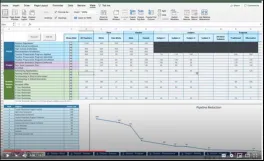
The Talent Development Data Tool
The Talent Development Data Tool is an easy-to-use, Excel-based tool to visualize teacher workforce data across the full educator career continuum. Users can disaggregate teacher workforce data to identify teacher shortages by segments like subject area, school type, income level, and geographic area.
The Talent Development Framework: Improving Access to Excellent Educators for All Students
Read the full Talent Development Framework (TDF) to begin your journey to proactively and purposefully address educator shortages and talent challenges in your local context. Our team can support your state in applying the principles of the TDF to meet the needs of your unique COVID-19 talent challenges.
Design Programs to Succeed Anywhere
The READI Framework: Design Programs to Succeed Anywhere
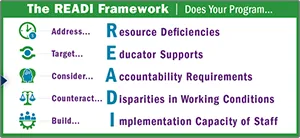
Underserved schools are often overlooked for district or state-wide initiatives because they may be perceived as lacking "readiness" for rigorous implementation. The READI Framework guides states and districts to examine five key barriers as they design programs and related supports for success in underserved schools.
Flipping the Readiness Paradigm
What does the READI Framework look like in practice? Explore this brief to see how the GTL Center has applied the READI Framework as a model in improving mentoring and induction programs and addressing educator shortages in underserved schools.
The READI Framework: Closing Gaps by Addressing the Needs of Low-Performing Schools
Explore the "readiness paradox," as well as the research and evidence behind the GTL Center's emphasis on designing programs to succeed anywhere, and especially in the schools that need them most.
Address Educator Shortages
Decision Points: Defining, Calculating, and Addressing Gaps in Access to Effective Educators
Explore four key decision points states should consider in measuring equitable access to effective educators. For each decision point, find state and local examples for initial determinations for equitable access policy and reporting, as well as ways states are supporting districts in identifying equity gaps.
Educator Shortages in Special Education: A Toolkit for Developing Local Strategies
Co-developed with the CEEDAR Center, this interactive tool helps users identify short-term strategies to meet immediate demand while paring them with long-term, systematic strategies that together create comprehensive solutions.
Expand Pathways Into the Profession

Emerging Pathways Into the Teacher Profession: Evaluating and Substantiating Their Effectiveness
In a new brief cowritten by AIR’s Center on Great Teachers and Leaders and the Center for Economic Evaluation, experts provide insights on how emerging pathways into the profession (e.g., Grow-Your-Own, teacher residency models, RTAPs) can be evaluated to determine their overall effectiveness and associated costs.
A Funding Guide for Supporting a Registered Teacher Apprenticeship Program With Federal and State Funds
Codeveloped with our partners at the CEEDAR Center, this funding guide is a helpful resource for practitioners and policy makers in the field trying to build an understanding of possible funding opportunities to grow and implement R-TAPs.

The Rising Cost of Becoming an Educator: Reimagining Pathways Into the Profession with Affordable, Cost-Effective, and Responsive Solutions
Assessing the impact of the student loan crisis on the teaching profession, this brief offers potentially promising and sustainable solutions that require reimagining current programming to include cost-effective and responsive solutions.
Take a Seat at the Table: The Role of Educator Preparation Programs in Teacher Apprenticeship Programs
AACTE, the GTL Center, and the CEEDAR Center co-authored this report and accompanying webinar to offer insights and recommendations for EPPs on how to be involved in the design and implementation of teacher RAPs alongside states and districts.
Elevate the Educator Profession
AIR's Teaching Conditions Survey
A valid, reliable survey centered on nine crucial teaching conditions factors, AIR's teaching conditions survey provides clients with dashboards and reports that visualize important feedback from teachers and noninstructional staff that policy-makers can use to improve teaching conditions, school culture, and school climate.
The Impact of a $10,000 Bonus on Special Education Teacher Shortages in Hawai'i
Co-authored with Center for Analysis of Longitudinal Data in Education Research (CALDER Center) at AIR and Boston University, this working paper examines the impact of a bonus policy implemented in 2020 by Hawai‘i Public Schools. Experts analyze how Hawai'i represents a unique but instructive case of how strategic financial incentives can help address special education teacher shortages.
Raising the Bar on Teacher Pay
Cowritten by the Teacher Salary Project, this brief presents a case for state and local policy makers to look at the data to make better decisions related to teacher salary increases. This brief highlights national research on current teacher salaries and their impact; outlines state-by-state data, exemplars, and guidance for making salary adjustments; and summarizes recent commitments to teacher pay made by state governors.
Teaching Conditions Toolkit: Using Data to Drive Teacher Retention
States and districts can use this five-part toolkit and handouts to create positive teaching and learning environments, raise teacher retention rates, and cultivate a positive school culture.
Teacher Leadership: Self-Assessment and Readiness Tools
The GTL Center's teacher leadership self-assessment and readiness tools can help educators as well as district and school leaders determine how prepared they are to implement or participate in a teacher leadership opportunity.
Teacher Leadership Toolkit 2.0: Strategies to Build, Support, and Sustain Teacher Leadership Opportunities
Designed to support states and districts in designing teacher leadership opportunities to facilitate meaningful change and support better outcomes for students. The toolkit includes a synthesis of research, current examples, and useful tools for design and implementation.
Compensation Matters: Recruiting and Retaining a Highly Qualified Workforce (Research Roundup, May 2024)
Our quarterly Research Roundup shares a quick summary of the most recently published studies on educator compensation. In this edition, learn about current versus historical compensation structures and how (or how not) compensations reforms can support expanding equity.
Teacher Leadership: Research Roundup (Research Roundup, May 2023)
Our quarterly Research Roundup shares a quick summary of the most recently published studies on teacher leadership. In this edition, discover new insights on how teacher leadership can impact instructional practices and school culture.
Rethink Professional Learning
Can a Teacher Professional Learning Program Reduce Teacher Burnout?
A new AIR impact study calls attention to a new potential lever to reduce teacher burnout—instructional coaching that focuses on teachers’ successes in the classroom. The study examined the impact of a program called MyTeachingPartner and found that the program increased participants' enthusiasm about teaching and lowered their negative sentiments about teaching.
Flipping the Readiness Paradigm
What does the READI Framework look like in practice? Explore this brief to see how the GTL Center has applied the READI Framework as a model in improving mentoring and induction programs and addressing educator shortages in underserved schools.

Magnifying Teachers' Successes: Insights from the MyTeachingPartner-Secondary Coaching Project
MyTeachingPartner is a web-mediated, strengths-based instructional coaching program that works to help teachers improve the quality of classroom interactions to boost student engagement and academic achievement. Explore insights from the program in our interactive story.
Mentoring and Induction Toolkit 2.0: Supporting Teachers in High-Need Contexts
States can use this toolkit to facilitate meaningful conversations with districts about design and implementation for teacher mentoring and induction programs, particularly in underserved contexts. The toolkit includes summaries of research and best practices, relevant examples, and a streamlined action planning process.
10 Mentoring and Induction Challenges in Rural Schools and How to Address Them
Strong, locally designed mentoring and induction supports can help to address the unique challenges faced by rural schools related to beginning teacher development and retention. This brief outlines 10 common challenges encountered by rural schools when implementing mentoring and induction programs along with strategies to address the challenges and examples from the field.