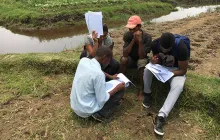
AIR is committed to advancing malaria modeling and early warning capabilities through the development of projection models that incorporate country‑specific parameters within a standardized, cross‑country framework.
The New Jersey Department of Labor partnered with AIR to refresh and scale its Industry Partnership model, NJDOL’s primary mechanism for convening regional employers and public partners around shared workforce priorities.
AIR and the National League of Cities are working together to gain a deeper understanding of the causes of city workforce challenges and designing solutions that city governments can adopt across the talent life cycle.
AIR is partnering with the Office of Energy Jobs at the U.S. Department of Energy to drive the adoption of sector strategies and support the development of a national energy workforce strategy.
July 14-16, 2026 : We invite you to gather with experts and district and secondary school teams from around the country to learn practical tools and strategies for building student-centered, data-driven systems of support.
A wealth of evidence shows that large-scale, government-run cash transfer programs consistently improve food security and help people make investments to generate income. But we need a more solid evidence base that supports planning and programming decisions.
Education experts and researchers from AIR will present several sessions at the Comparative and International Education Society (CIES) 2026 Annual Conference being held March 28 – April 1 in San Francisco, California.
Early warning systems, like Famine Early Warning Systems Network (FEWS NET), may help decisionmakers and relief agencies plan for and respond to malaria risk, like they do for other humanitarian and public health crises.
The Middle School Collaborative Language Acquisition Strategies (MS CLASS) program helps Grade 6–8 teachers learn simple, effective ways to enhance their general instruction while also supporting emergent bilingual students.