Workforce Pell: Expanding Access to Short-Term Job Training

The Pell Grant program is the federal government’s primary way of helping low‑income students pay for postsecondary education without taking on debt. Until now, Pell funding has been limited to longer-term degree and certificate programs. House Resolution 1, also known as the One Big Beautiful Bill Act, expands Pell eligibility to shorter-term training programs

Starting in July 2026, learners can use Workforce Pell Grants for 8–15-week programs that lead directly to in-demand jobs. Workforce Pell Grant programs will prepare learners for careers in fields such as information technology, healthcare, vehicle operation, skilled trades, and early childhood education

While these recent updates to federal financial aid are expanding how Pell Grants can support workforce training, the funding pathway available to a student still depends on the type of program and the student’s educational background. Workforce Pell will allow eligible students to use Pell Grants for certain short-term credential programs aligned with labor market demand.
 

Who Can Use Workforce Pell?

Students are eligible for a Workforce Pell Grant if they are enrolled in an eligible workforce program at a qualifying accredited institution, have not attained a graduate degree, and otherwise meet the eligibility criteria for a Pell Grant. 

Students without a high school diploma or GED may still qualify for federal aid through Ability to Benefit if they demonstrate readiness for postsecondary education through an approved test, completion of six college credits, or participation in an eligible career pathway program. 

Even with expanded Pell eligibility, other funding sources such as the Workforce Innovation and Opportunity Act (WIOA), state workforce grants, or institution-based financial aid or scholarships will continue to play an important role, particularly for covering supportive services like transportation, childcare, or training equipment.
 

When Will Workforce Pell Be Available?

Timeline and Process: Rulemaking to Implementation

Here’s what we know: the U.S. Department of Education (ED) published final rules on May 19, 2026, establishing the core eligibility, approval, and accountability requirements for Workforce Pell. 
Image
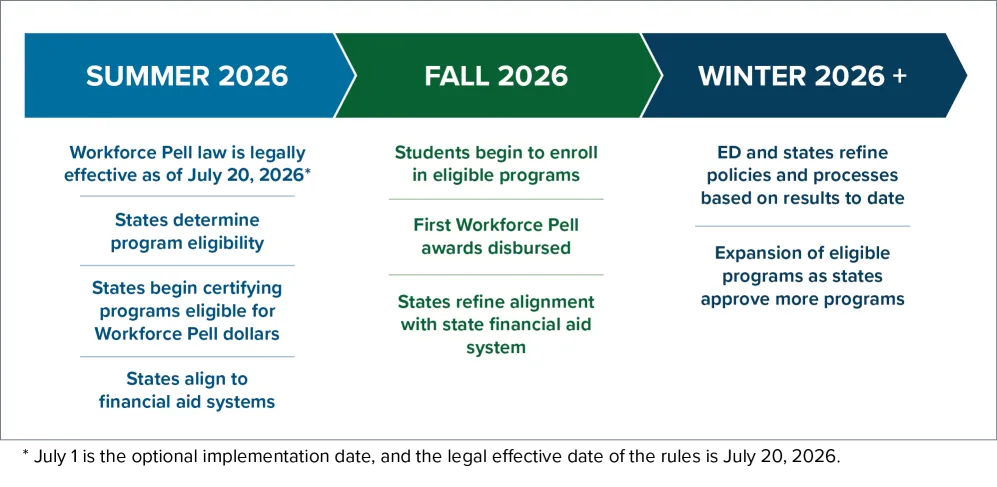
Workforce Pell Timeline 2026

The legal effective start date for Workforce Pell is July 20, 2026, but there is no guarantee that programs will be ready to enroll students. States must still establish approval processes, define eligible occupations, determine eligible programs, and coordinate across workforce and higher education systems. Further, any institution that elects to participate in Workforce Pell through a qualifying program between July 1, 2026, and July 20, 2026 has elected to implement the provisions early.

States and institutions will move at different speeds, and early activity likely will focus on policy development rather than immediate enrollment.  
 

Understanding Workforce Pell Rules and Resources

Below, we summarize requirements and processes for Workforce Pell, as outlined in ED’s final rules published on May 19, 2026; the legal effective date of these rules is July 20, 2026.

Program Approval Process

The Workforce Pell approval process involves multiple stages of review at the institutional, state, and federal levels to ensure that short‑term programs align with workforce needs and meet accountability requirements. The steps highlighted in this Workforce Pell Approval Process Infographic outline how a program moves from initial development to Workforce Pell eligibility. It outlines the roles of institutions, governors, and ED, as well as ongoing reporting and recertification requirements to maintain approval.

Program Eligibility
  • Credit articulation. Programs must articulate into a related credit‑bearing certificate or degree at the same institution or at least one other institution, with written verification.
     
  • Eligible programs. Programs must be 150–599 clock hours (8–15 weeks); be aligned with high‑skill, high‑wage, or in‑demand occupations; meet student completion and job placement rate requirements; demonstrate that programs yield positive educational and labor market outcomes; articulate into a related credential; lead to a recognized postsecondary credential; and have operated while meeting all requirements for at least 12 months prior to approval.
     
  • Working with ineligible programs. Working with ineligible entities. Under a written arrangement, an eligible institution generally may not have an ineligible institution or organization provide more than 25% of an eligible workforce program. For related instruction components of Registered Apprenticeship programs, an ineligible entity may provide more than 25% but less than 50% of the program with accreditor approval.
     
  • Registered apprenticeships. Registered apprenticeship programs may participate by counting the related technical instruction (RTI) component that independently meets Workforce Pell requirements (completion, placement, recognized credential). Registered apprenticeship status automatically satisfies the high‑skill, high‑wage, or in‑demand criterion.
     
  • Online out-of-state programs. Online Workforce Pell programs may enroll students across state lines only through bilateral agreements between governors. The governor in the institution’s home state must approve the program, and the governor in the student’s state must separately determine that it aligns with local workforce needs. These agreements must also include data‑sharing provisions to support state certification of completion and job placement outcomes.
What This Means in Practice for Program Design
Short program durations can increase administrative complexity and the likelihood of compliance errors, particularly in areas such as monitoring satisfactory academic progress, calculating enrollment intensity, and performing Pell Grant recalculations. These risks arise because shorter timelines require more frequent evaluations, precise tracking, and timely adjustments to student records. 

As a result, programs should be designed from the outset with completion and job placement in mind. Stackability should be clearly defined through written, verifiable articulation agreements. In addition, tuition setting becomes a strategic decision that can directly affect program viability, rather than simply a pricing choice.
State Responsibilities
  • Program approval. Governors must approve every Workforce Pell program enrolling students in their state and certify alignment with state high‑skill, high‑wage, or in‑demand definitions (as established under WIOA and Perkins), employer demand, meaningful credit articulation, and 12‑month compliance with eligibility requirements (including for out‑of‑state programs).
     
  • State approval in reciprocity situations. Governors must approve any Workforce Pell program enrolling students located in their state, even when the institution participates in state authorization reciprocity. States may enter into bilateral agreements to streamline approvals where appropriate (e.g., among neighboring states).
     
  • Review cadence. States must maintain transparent, consistent, and fair approval procedures and review determinations at least every two years, aligned with the WIOA state plan cycle.
     
  • Federal oversight. Following gubernatorial approval, ED applies a 12‑month lookback to verify compliance and administers the value-added earnings (VAE) test (see “Annual ED calculation” under “Institutional Accountability and Risk”) using federal earnings data, with authority to determine eligibility, enforce price‑to‑value requirements, and assess liability for noncompliant programs.
     
  • Calculate completion and job placement rates. States will calculate annual completion and job placement rates, as they can include all students (not just Workforce Pell recipients) and generally have more complete employment data. States will not be required to calculate completion rates after the 2028–29 award year but will have to calculate job placement in perpetuity.
     
  • Written verification required. States must verify in writing, through articulation agreements, transfer‑of‑credit policies, consortia, or comparable documentation, that Workforce Pell credits are accepted by the same institution or by one or more other institutions.
     
  • State discretion to strengthen requirements. States may go further by requiring that credits articulate into a related program of study and that short‑term credentials count toward degree or certificate requirements, rather than as elective credit.
What This Means in Practice for States
Workforce Pell creates several concrete responsibilities for states. States must establish written approval criteria, develop review and appeal processes, and build capacity for ongoing monitoring. Implementation also requires coordination across workforce and higher education agencies. Approval is not permanent, and programs can lose eligibility over time. Changes in political leadership or state priorities may also affect continuity.
Institutional Accountability Risk
  • Career pathways misalignment. Students who continue on to a bachelor’s program are included in job placement calculations and may be counted as unemployed, effectively treating continued education as a negative outcome.
     
    • Limited exclusions. Students may be excluded from job placement calculations only due to death, documented medical conditions preventing work, incarceration, or active‑duty military service. Continued education is not an exclusion.
       
    • Transitional on‑ramp. States may use existing administrative data for job placement calculations through 202728; beginning in 2028–29, placement must be measured based on employment in the occupation(s) the program prepares students for, or in comparable occupations.
       
  • Calculations for out-of-state students. Programs with more than half of students residing outside the state where the program is located will be compared using national price parity.
     
  • Timing. Earnings are measured using the first full tax year after completion; tuition comparisons reference the cohort from three years prior (e.g., 2026 completers’ earnings measured in 2027, with VAE determination in 2029).
     
  • Annual ED calculation. ED will calculate VAE once per year using a standardized formula:

VAE = (Median earnings of program completers three years after exit [adjusted for regional cost of living] - 150% of the federal poverty level) − published tuition and fees.

  • Price enforcement. If tuition exceeds VAE, institutions must immediately reduce charges below VAE. Continued over‑charging results in program ineligibility for the entire award year, applied retroactively.
     
  • Consequences. Confirmed VAE failure triggers loss of eligibility and may subject the institution to liability for Pell funds disbursed during the failing year.
     
  • Failure to meet completion or placement requirements results in loss of program eligibility. Programs will have a two‑award‑year waiting period before they may reapply. “Substantially similar” programs cannot be approved during the waiting period, preventing evasive rebrands.
     
  • Failure to meet VAE requirement triggers liability and loss of eligibility. The pathways to reinstatement require updated governor certification, tuition documentation/attestation, and VAE recalculation for the next award year.
     
  • Reporting and certification. States are explicitly responsible for annual oversight and certification, with institutions providing required data and later assuming completion-rate calculations while job placement remains a state accountability function. Institutions must submit completer lists and required student information to enable the state’s calculations. Placement is measured as employment during the second quarter after exit, aligned with WIOA performance indicators.
     
  • Accountability. Minimum 70% completion and job placement rates are required, alongside passage of the VAE test (median completer earnings minus 150% of the federal poverty level exceeds tuition and fees). Under the final rules, self-employment is considered part of the 70% job placement and excludes students from VAE calculations if the student was enrolled in any other educational program at the institution or at another eligible institution during the calendar year.
     
  • Accountability in 2029–30 and beyond. Students must be employed in the occupation the program prepares them for, or in a comparable high‑skill, high‑wage, or in‑demand occupation. This requirement does not take effect until after the three-year transition period (i.e., 2029–30 academic year).
     
  • Known Unknown. How states will submit governor certifications and in what format is still to be determined. However, ED is currently seeking Office of Management and Budget (OMB) approval for a new form to utilize for Governor approval requirements. Additionally, although there is a clearly defined 15-day decision notification requirement, the expected turnaround times for appeals and recertifications are not described.
What This Means in Practice for Institutional Risk
Programs can lose eligibility even after students are enrolled, and in some failure scenarios, institutions, not students, bear the financial liability. Small cohorts may face additional risk because of how earnings are aggregated for accountability measures. Accurate data collection and reporting are essential to maintaining eligibility and should be treated as core program requirements rather than administrative afterthoughts.

What is AIR Currently Working on Related to Workforce Pell?

What This Means in Practice
AIR can support states and institutions in assessing readiness for Workforce Pell, not just determining eligibility. This includes helping to align data systems and design governance structures needed for implementation. 

AIR can also help colleges determine when Workforce Pell is the right option and when other supports, such as Integrated Education and Training Pell or WIOA, may be more appropriate. In addition, clear student-facing communication is critical to prevent Pell exhaustion and reduce confusion about available aid.

AIR is advancing early‑stage efforts to support effective Workforce Pell implementation, with an emphasis on helping states and institutions translate new approval, data, and accountability requirements into practice. 

Our work focuses on identifying common implementation challenges (including state approval processes, job placement data access, and cross‑agency coordination) and using those insights to shape potential technical assistance approaches that promote readiness and sustainability. 

As part of this work, AIR is building a Workforce Pell resource repository for Higher Education in Prison providers to identify gaps in support and guidance and support the potential development of targeted guidance for program administrators. We are also planning technical assistance for the workforce system as part of the Next Level Now collaboration with the U.S. Department of Labor.

Contact
Sudie Whalen

Sudie Whalen

Senior TA Consultant
Amanda Ahlstrand

Amanda Ahlstrand

Managing Director