Rhode Island Tiered Interventions in Math Education (RI TIME)

In 2021, the Rhode Island Comprehensive Assessment Systems (RICAS) showed that less than 5% of 8th grade students with disabilities were proficient in math, compared with 18.5% of their peers without disabilities. Prior to the pandemic, 59% of students with disabilities taking the Math RICAS showed either typical or high growth; in 2021, that percentage had dropped to 33%. These post-pandemic assessments highlighted significant learning gaps for students with disabilities in mathematics.
To address this need, in 2022, the Rhode Island Department of Education (RIDE) funded AIR to launch the Rhode Island Tiered Intervention in Math Education (RI TIME) project, designed to improve math learning outcomes for students with disabilities in grades K-8. RI TIME provides support to RIDE in the implementation of their State Systemic Improvement Plan through technical assistance targeted to state and local education agencies as well as school and district staff.
Our Approach
AIR has supported RIDE in addressing gaps in math learning outcomes for students with disabilities in math since 2016. From 2016 until 2022, AIR was funded to lead the RI Intensive Math Project, with a goal to improve learning outcomes for students with specific learning disabilities in grades 3-5. In 2022, the project scope expanded to focus on improving math outcomes for students with disabilities in grades K-8, measured by growth on the 8th grade math RICAS.
RI TIME provides universal and targeted technical assistance to Rhode Island educators through the development of self-paced modules, factsheets on evidence-based math practices, and an ongoing topic-oriented podcast and book study. Explore the resources.
AIR staff provide a range of technical assistance to RIDE, local education agencies, and Rhode Island educators through professional learning and coaching on the delivery of accessible evidence-based math instruction across tiers of support and within specially designed instruction.
Professional learning activities utilize a Multi-Tiered System of Supports (MTSS) framework and the data-based individualization framework (DBI) to improve educator capacity to implement evidence-based math instruction. Our approach targets all levels of the educational system to drive change that is both top-down and bottom-up—building individual educator capacity to change practice while also building the systems necessary to support lasting change and improved outcomes for students with disabilities.
In collaboration with the West Bay Collaborative and the Rhode Island Parent Information Network, the AIR team:
- Supports Rhode Island districts in the implementation of MTSS through the development of supportive tools, resources, and self-paced learning modules housed on the BRIDGE-RI professional development platform;
- Generates timely and actionable guidance and resources for educators on evidence-based math strategies to support students with disabilities;
- Provides support for family engagement through family-friendly infographics, videos, and fact sheets on evidence-based math instruction and specially designed instruction (available in English and Spanish); and
- Delivers intensive coaching in multiple districts and school sites across the state to support robust MTSS implementation that leverages the DBI process as a framework for intensifying support for students with disabilities.
Our Impact
Since 2022, the State Identified Measurable Result for math outcomes for students with disabilities has been met and exceeded each year. In addition, grade 8 students with disabilities at our project sites are more likely to show typical or high growth than the statewide average for students with disabilities, pointing to higher growth associated with sites that actively engage with RI TIME targeted coaching supports.
On the 2020-2021 Math assessment for grades 3-8, 11 out of 19 participating schools had a higher percentage of students achieving high growth when compared to the state average; 13 out of 19 participating schools had a higher percentage of students achieving typical growth when compared to the state average.
RI TIME Educator Resources
Self-Paced Learning Modules
In partnership with MTSS-RI, AIR has created multiple self-paced learning modules hosted on the BRIDGE-RI platform. Each course is designed to provide K-8 RI educators with evidence-based strategies that they can implement in their classrooms to improve mathematics learning outcomes for students with disabilities.
One-Pagers on Evidence-Based Practices in Mathematics
- Helping Students Build Computational Fluency Through Independent Practice
- Helping Students With Transitioning From Visual to Abstract Understanding
- Helping Students With Math Fact Fluency: Cover-Copy-Compare
- Helping Students With Word Problems: Schema-Based Instruction: Multiplication Schemas – Comparison Problems
- Helping Students With Word Problems: Schema-Based Instruction: Multiplication Schemas - Equal Groups Problems
- Helping Students With: Word Problems: Schema-Based Instruction: Additive Schemas – Combine Problems
- Helping Students With Word Problems: Schema-Based Instruction: Additive Schemas – Change Problems
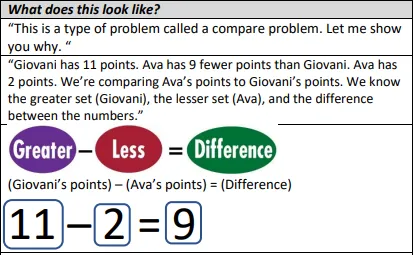
- Helping Students With Word Problems: Schema-Based Instruction: Additive Schemas – Compare Problems
Math Chat Podcast
As one of the professional development opportunities offered to RI educators, the RI TIME project produces the podcast Math Chat, which can be found on Spotify. Each season follows a different book in the field of math and special education, and episodes often feature expert researchers in the field. Educators across Rhode Island are invited to participate in the twice-yearly book study, which entails reading the selected book and listening to the podcast episodes at their own pace.
Parent and Caregiver Resources
RI TIME provides universal technical assistance to Rhode Island educators, families, and caregivers through the development of flyers, infographics, resources, and fact sheets, available in English and Spanish. In addition, in response to feedback gathered through surveys of families and caregivers, RI TIME created a series of curated playlists on supporting math learning at home, targeted by grade level and content area.
Factsheets and Infographics for Families
- Homework: A Helpful Overview
English | Spanish
- Understanding Your Child's Math Homework: Concrete-Representational-Abstract
English | Spanish
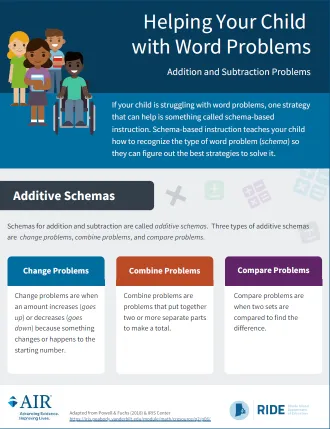
- Helping Your Child with Word Problems – Addition and Subtraction
English | Spanish
- Helping Your Child with Word Problems – Multiplication and Division
English | Spanish
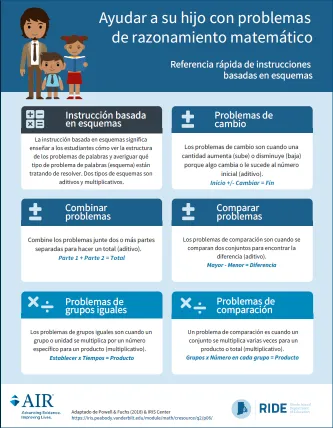
- Helping Your Child with Word Problems – Schema-Based Instruction Quick Reference
English | Spanish