Better Texts, Better Attendance: Family Insights on Attendance Communications

Absenteeism from school is a chronic, widespread challenge in education that has far-reaching consequences for students of all ages.
Absenteeism rates have nearly doubled from pre-pandemic years, and rates remain persistently high across the country. The rise in absenteeism is a growing issue affecting all students, and signals a broader mindset shift in how students and families engage with school.
Schools and districts across the U.S. are looking for effective programs that can improve attendance and increase a student’s chances of success. Research completed in the wake of the pandemic shows that rates of chronic absenteeism are lower when there is stronger family engagement.
The Role of Text Messaging in Promoting Student Attendance
AIR facilitated conversations with families to explore the role that sending text messages to families has in promoting student attendance. The resulting brief presents key insights families shared during the conversations about school-based text messages:
- Families from two districts in Iowa were asked questions about what they hope to see in a text from their child’s school about attendance.
- The report also offers strategies for schools and districts that use, or are considering using, text messaging to promote attendance.
As schools develop their family engagement strategies, the key takeaways from these facilitated conversations provide considerations that schools and districts can use to understand the evolving perceptions that families have about attendance.
As part of a related project, the AIR team put together an actionable toolkit detailing 8 specific steps for districts and schools to follow to implement a text messaging strategy.
Read the 8 steps.
Key Insights: How to Craft Engaging Text Messages for Families
Research has found that families respond better to messages that highlight whole-child development and positive outcomes of attending school, instead of messages focused on the negative consequences of absenteeism.
Below are some considerations detailed in the report about crafting text messages for families. Pre-pandemic text messages that are provided as examples below are generalized from a literature review AIR conducted to summarize strategies for writing text messages to families about school attendance.
- Intentional use of multiple communication methods. Families stressed the importance that schools have a specific purpose for each communication method used. For example, emails are useful for sharing detailed information and linked resources, and text messages are useful for notifications that require time-sensitive action.
Personalize messages and include a point of contact.
- When possible, messages should mention the name of the student, family member, and/or teacher.
- To reinforce person-to-person connection, text messages should be sent from a trusted adult in the school, such as a teacher, counselor, or principal and include a point of contact for families to contact with questions or corrections.
Image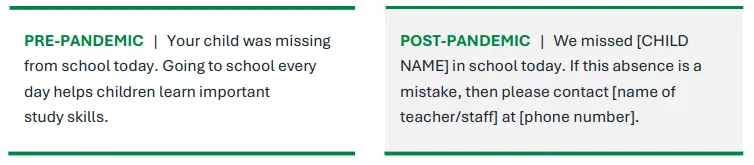
Ensure that messages are informative and not judgmental.
- Use a professional tone when writing messages and include factual information. A critical tone will not build trust or goodwill between families and schools.
Image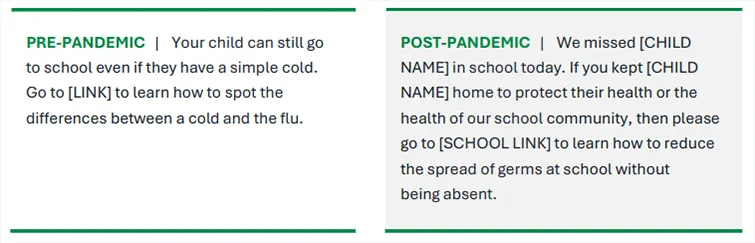
- Use a professional tone when writing messages and include factual information. A critical tone will not build trust or goodwill between families and schools.
Create simple messages.
- Find ways to simplify the messages such as:
- Using number of days absent instead of percentages.
- Keeping messages short and to the point, aiming for a maximum of 160 characters to ensure the message is easily readable.
- Using accessible language to ensure all families can read and understand the message, avoiding jargon or abbreviations that might confuse readers.
Image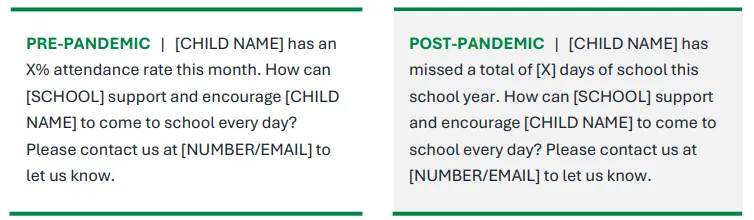
- Find ways to simplify the messages such as:
Better Texts, Better Attendance: Family Insights on Attendance Communications (Webinar)
AIR hosted a webinar on September 30, 2025, sharing key insights from family focus groups about effective attendance communication. The webinar shared family preferences about receiving messages about attendance from their child’s school and next steps for districts and schools launching a text-based attendance campaign. View the presentation slides.