Balance the Equation: Expanding Opportunity and Achievement in Algebra I

Algebra I is a critical milestone in student learning and serves as a key indicator of college readiness.
The Balance the Equation Algebra I Grand Challenge was launched by the Gates Foundation in Fall 2020 to identify and study innovative solutions aimed at improving math outcomes for students who are Black, Latino, affected by poverty, or designated as English learners.
The Algebra I Grand Challenge was the first education Grand Challenge hosted by the foundation. They funded 15 grantees in Spring 2021 to refine and design a study of their solution for improving student outcomes and funded ten of those grantees in Summer 2021 to conduct the studies of their solutions.
AIR as a Learning Partner
AIR served as a learning partner for the Gates Foundation and the grantees. For example, AIR:
- Supported the foundation to identify areas of focus for the Algebra I Grand Challenge;
- Worked with grantees to develop and conduct studies of their solutions;
- Analyzed data to understand implementation and impact of the solutions; and
- Synthesized findings across solutions and studies.
Additionally, AIR developed numerous resources to support both the foundation and grantees:
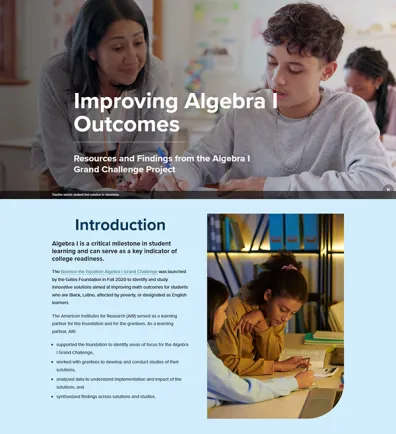
Interactive Story: Improving Algebra I Outcomes
This interactive story uses a timeline of the project to guide you through the resources below, and showcases some of the grantees' solutions.
Results Summary
This summary provides an overview of study designs, teacher and student outcomes findings, and suggestions for future exploration.
Theory of Action
A theory of action is how a team envisions a program working to produce the outcomes that are hoped for. AIR worked with the Gates Foundation to develop a generalized theory of action which was updated by each grantee for their specific project.
Common Measures
- Teacher Survey Measures. AIR developed common teacher surveys that were used across projects to measure beliefs about student math learning, skill in adapting curricula and instruction to meet student needs, and the use of effective math instructional practices.
- Student Survey Measures. Similarly, AIR developed common student surveys that were used across projects to measure student experience and math identity.
- Student Survey Psychometric Analysis: Executive Summary. This summary describes the psychometric analysis conducted on the student survey Cohort 2 data.
Conducting Research
- Types of Research Design 101. This interactive resource provides an overview of the different types of research designs ranging from case studies to randomized-controlled trials. View the 508-compliant PDF.
- Correlational Study Design 101. This resource is an introduction to correlational study design and how a correlational study fits within the project’s goals.
- Comparison Study Design 101. This resource is an introduction to comparison study design and how a comparison study fits within the project’s goals.