Center on Advancing Measurement and Assessment
We are committed to improving measurement and assessment to maximize opportunities for all young people and adults to learn and thrive.

Resources
The Center on Advancing Measurement and Assessment offers a collection of publications and tools for those looking to learn more about developing or selecting evidence-based measures or tools.
Publications
Coordinating Skills-Based Hiring and Competency-Based Education Practices
AIR is working with employers and postsecondary institutions to study, understand, and track the adoption and maturation of skills-based practices.
What We Learned from PIAAC: Relationships Between Parental Education and Adult Socioeconomic Outcomes
The brief highlights the main findings from dozens of national and international reports and research papers that utilize Program for the International Assessment of Competencies (PIAAC) data to explore the relationship between parental education and a range of adult outcomes..
What We Learned from PIAAC: Skills and Economic Outcomes of U.S. Immigrants and Their U.S.-Born Offspring
The report brings together the results of 24 reports and research studies that use Program for the International Assessment of Competencies (PIAAC) and other datasets to explore the skills and education of U.S. immigrants and their working-age children. Collectively, these studies shed light on the economic outcomes of immigrants (e.g., employment and income), the significant diversity within the immigrant population, and the policies that may reduce their barriers to success in the knowledge-based economy.
Identifying the Nation's Lowest Performing Schools: Shifts Following the Passage of the Every Student Succeeds Act (ESSA)
The report examines if ESSA played out as policymakers expected or if there were any other, perhaps less expected, consequences for the number, types, and composition of schools that states identified and examines this issue by comparing schools identified for the most intensive supports just before and just after ESSA’s implementation.
Supporting Whole-Child Development: Survey Findings From a National Sample of U.S. Teachers
To understand how teachers are promoting whole-child development, AIR analyzed survey data from a nationally representative sample of K-12 public school teachers using RAND’s American Teacher Panel. The three brief reports in this series present results for three topics, and an appendix provides the full set of survey questions.
NAEP Data in Focus: Examining the Research
The National Assessment of Educational Progress (NAEP), led by the National Center for Education Statistics (NCES) within the Institute of Education Sciences (IES), is the only nationally representative and continuing assessment of what America's students know and can do in various subject areas. AIR informs the NAEP program and the research community through our work, NAEP Data in Focus. The NAEP Data in Focus working papers combine AIR’s expertise and experience not only with NAEP, but with other large-scale assessments and survey-based longitudinal studies. The papers are made available to researchers and the public.
Pressing Needs in Research on K-12 Civic Learning: A Call to the Field
Although young people learn about democracy and ways to engage in civic life through family, peer groups and communities, K-12 schools play a role in formally educating large numbers of students and preparing them to participate in our democracy. In this brief, the authors discuss the need for action in two inter-related areas to help address the current state of democracy through the promotion of K-12 civic learning: measurement and causal research.
Synthesizing NAEP and International Large-Scale Assessment Score Trends: A Pattern of Diverging Performance
Bringing together results from NAEP and three international large-scale assessments (ILSAs), this report examines long-term intermediate, and recent score trends in reading, mathematics, and science for U.S. students in 4th grade, in 8th grade, and at 15 years old. The publication includes a Stats-at-a-Glance, a research brief, and a research note.
Why It's Necessary to Accurately Measure Employee Skills and How to Do It
This brief offers five questions that highlight different facets relevant in the validation of skills that may be helpful in identifying areas of organizational policy and practice that can be rethought or refined.

Measuring Skills at Work: Lessons from the Field
Funded through a grant from Walmart, this report presents the results of research that looked at the landscape of employer skill validation practices and the systems and tools that support them through case study interviews with 10 employers and 5 tool providers.
Changes Between 2011 and 2019 in Achievement Gaps Between High- and Low-Performing Students in Mathematics and Science: International Results from TIMSS
This Statistics in Brief uses data from the 2011 and 2019 Trends in International Mathematics and Science Study (TIMSS), and explores how achievement gaps between high- and low-performing 4th- and 8th-grade students in the U.S. and other education systems have changed over time. The SiB focuses on two questions for each grade and subject: (1) In which education systems did score gaps between high- and low-performing students change (widen or narrow) between 2011 and 2019? (2) Is the widening or narrowing of score gaps between 2011 and 2019 driven primarily by changes in the scores of high-performing students, low-performing students, or both?
Maryland College and Career Readiness Empirical Study: Final Report
This report for the Maryland State Department of Education presents the findings from an empirical study of Maryland's college and career readiness (CCR) standard. The study includes a predictive validity analysis and a content and standards alignment analysis.
Accelerating Progress in U.S. Education: Key Lessons from Other Federal R&D Investments in Technology and Innovation
To help inform the vision for the National Center for Advanced Development in Education (NCADE) within IES, this brief describes lessons learned from features of the Defense Advanced Research Projects Agency (DARPA) and similar R&D focused agencies such as the Advanced Research Projects Agency-Energy (ARPA-E) in the Department of Energy.
Tools
Student Well-being Instruments Database
This database, developed in collaboration with AIR and the Annenberg Institute at Brown University, serves as a valuable collection of measures related to student well-being.
National Center on Intensive Intervention: Tools Index
The National Center on Intensive Intervention has developed six tools charts to assist educators and families in becoming informed consumers who can select academic and behavioral assessment tools and interventions that meet standards for technical rigor and address their specific needs. Explore this overview of available tools charts and considerations for using them to identify assessments and interventions.
Standards and Assessments (S&A) Ecosystem
The AIR S&A Ecosystem provides a cohesive and comprehensive structure to guide states and districts in the development of standards-based systems. This interactive tool walks users through a six-step process for creating a standards-based education system that ensures all students are prepared for college, careers, and military service.
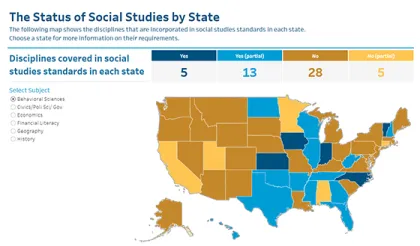
Social Studies Standards Map
Explore this interactive U.S. map that AIR developed to show the disciplines that social studies standards cover in each state.
AIR's Ready to Implement Toolkit
Education leaders, staff, and teams can use this research-based resource from AIR to learn about what readiness is and why it is important to consider when making data-driven decisions. The toolkit features a high-quality readiness assessment alongside the Ready Resource Library, which provides relevant tools to help build readiness.