Launching Field Trials With Confidence: A Starter Toolkit for Educators and Researchers
Field trials test the impact of an education program (e.g., program, policy, curriculum). These trials answer important questions for schools: what works, for whom, and under what conditions. Field trials need careful planning, clear guidance for consistent implementation, and ample resources.
Program providers are organizations that develop education programs for school settings. Providers are busy and often have limited knowledge of how to plan for a field trial. This toolkit helps bridge that gap. It offers practical tools and templates designed for real-world use. The toolkit will help program providers work with research teams such as research organizations or universities.
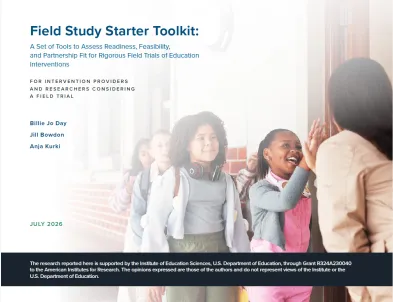
The Field Study Starter Toolkit is a free resource. It guides providers through the process of deciding whether to conduct a field study and how to get started. Providers can use the toolkit to assess readiness for a field trial and examine whether implementation of the intervention is feasible in educational settings. Additionally, the research partners can use the toolkit to clarify roles and expectations for the provider and research organization during the field trial.
Download the interactive toolkit | Download the 508-compliant PDF
The Challenge: Preparing for a Field Trial Is Complex
Pilot studies and internal evaluations often focus on feasibility, and providers use them to inform program improvement. Field trials, on the other hand, test whether an intervention produces intended outcomes in specific settings, such as during the school day, after school, or in virtual environments. Well-executed field trials measure the impact of the product on student and educator outcomes.
Schools, districts, and other education leaders prioritize the use of evidence-based interventions. Many providers seek to prove the effectiveness of their interventions. Field trials can generate this evidence. However, they require investments of time, funding, and coordination. Because the quality and usefulness of findings depend on careful preparation, providers may need clear guidance in several areas:
- What field trials require;
- How to assess whether their intervention is ready for a field trial;
- How to define and document the implementation model; and
- How to clarify roles and responsibilities across partners.
The Field Study Starter Toolkit addresses this need with practical tools that help organizations assess readiness and take next steps. The toolkit includes three core tools:
- A Readiness for Rigorous Field Trials Tool to determine whether an intervention is ready for a rigorous study.
- An Implementation Feasibility and Fit Analysis Tool to examine how the intervention will work in real settings.
- A Roles and Responsibilities Planning Guide Tool to define expectations and support coordination across partners.
Moving Forward With Confidence
Together, these three tools provide structured yet flexible support for field trial preparation. The tools help research partners get on the same page, address important questions, and move forward with a plan. This approach balances strong research with real-world practicality.
The research reported here is supported by the Institute of Education Sciences, U.S. Department of Education, through Grant R324A230040 to the American Institutes for Research. The opinions expressed are those of the authors and do not represent views of the Institute or the U.S. Department of Education.