Katie Rich
Katie Rich is an expert in math and computer science (CS) education. She is trained in qualitative and mixed-methods research methods and has extensive experience in curriculum design and development with attention to integration of CS into other subjects. At AIR, she develops and leads a variety of research and technical assistance projects in math and CS education, educational technology, and related teacher professional development, with a particular focus grades K-8. She also serves on the math leadership team and as director of CS@AIR: The Center for Evolving CS Education.
Dr. Rich’s recent work in math education focuses on evaluating the impact of core and supplemental math programs on student outcomes and on understanding how teachers bring their expertise into the process of program implementation. She served as the lead developer and a pilot coach for the Engagement and Achievement through Computational Thinking (ENACT) partnership within the Regional Educational Laboratory Midwest, a professional development and coaching program designed to support sixth-grade mathematics teachers to integrate computational thinking and student-focused practices into their instruction. She also served as the implementation study lead for the Classwide Super Solvers + Peer-Assisted Learning Strategies (CSS+PALS) project, where she developed measures and analysis strategies to describe how teachers implemented a supplemental fractions program. Finally, Dr. Rich recently led a randomized control trial (RCT) evaluation of a 4-week fractions program incorporating executive function skill development and physical activity into math learning activities.
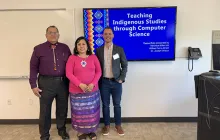
Dr. Rich’s recent work in CS education focuses on working shoulder-to-shoulder with practitioners at the state, district, and classroom level to develop innovative ways to implement elementary CS education. She serves as the principal investigator (PI) of two National Science Foundation research-practice partnership grants related to elementary CS. As PI of the Wind River Elementary CS Collaborative, she supports teachers of Northern Arapaho and Eastern Shoshone students to use CS instruction as a strategy for supporting cultural and linguistic revitalization efforts on the Wind River Reservation in Wyoming. As PI of the Pacific Northwest Elementary CS Collaborative, she works with state leaders in Idaho, Washington, and Oregon to develop strategies for supporting rural districts to create locally tailored elementary CS education pathways through partnerships with industries present in the district communities. Dr. Rich also supported the Wyoming Department of Education to develop and implement a set of CS micro-credentials for students and teachers. She served as an expert reviewer of teacher and student submissions and co-led the development of supplemental Canvas courses to support students and teachers to complete the micro-credential requirements.
Dr. Rich is dedicated to sharing her work with a variety of audiences to support its use as a tool for improving education of students nationwide. She has written blog posts about math virtual manipulatives and CS microcredentials and published her work in researcher and practitioner journals such as Mathematics Teacher: Learning and Teaching PK-12, Digital Experiences in Mathematics Education, and the Journal of Computer Science Integration. She has also given numerous talks and led several workshops at conferences, including the American Educational Research Association (AERA) Annual Meeting, the National Council of Teachers of Mathematics (NCTM) Annual Meeting, and the Special Interest Group in Computer Science Education (SIGCSE) Technical Symposium.







Ph.D., Educational Psychology and Educational Technology
Michigan State University
M.A., Learning Sciences
Northwestern University
B.A., Mathematics
Western Michigan University